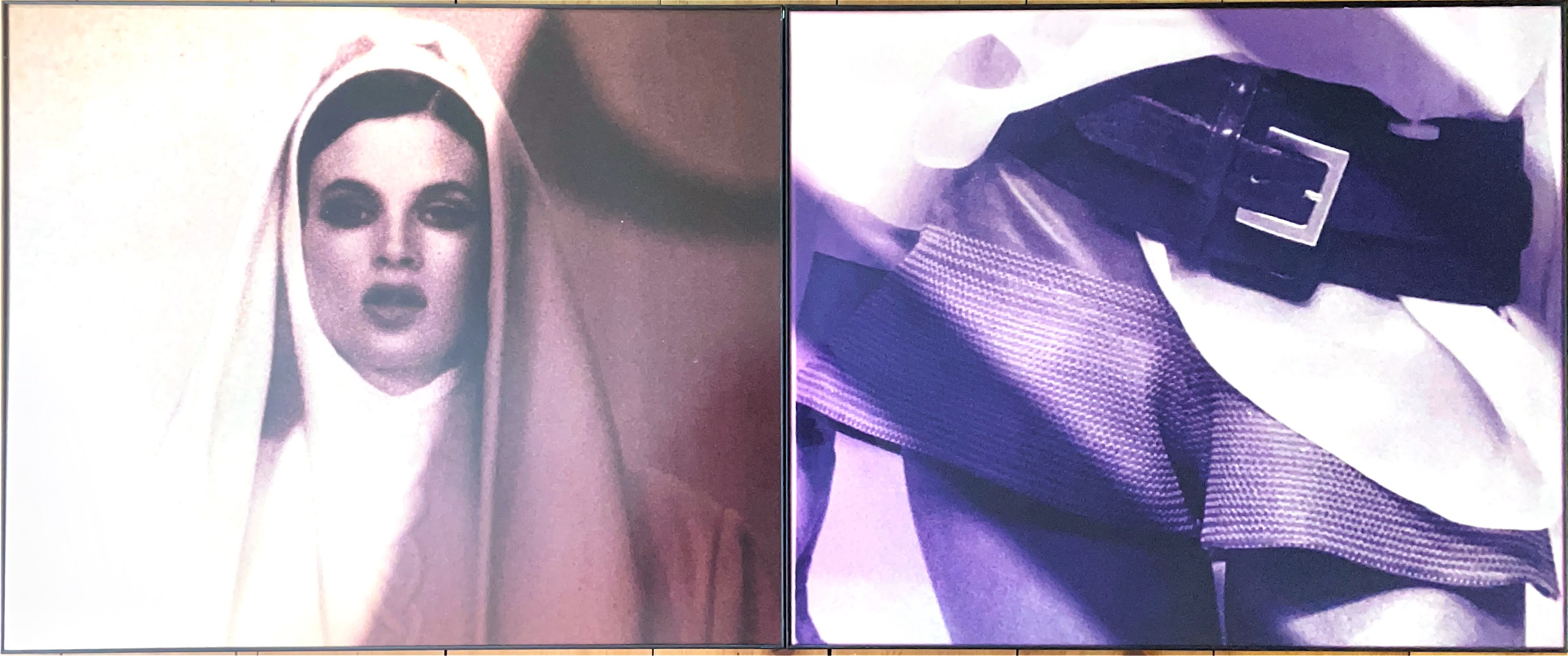
Image by: Philipp Burwinkel
My Beautiful Incest
2: On the Longing of Child and Mother in Louis Malle's Murmur of the Heart
26.07.2026
Disturbed illusionistic sadistic personalities, disfigured alienated bodies, murderous violent hillbillies, hermitic neglect, entire genetically defective villages, moral absence, degenerate dimwits define the pop-cultural idea of that building block leading predominantly to thriller and horror: incest. Well-known films like Hitchcock’s Psycho, The Texas Chain Saw Massacre, the Wrong Turn franchise, The Crimson Rivers are merely examples of a gleefully perverted fascination with sex between blood relatives and its consequences. Often incest is not even a primary motif but directly implied through visual connotation, one that seems to have been trained into us as a plausible driver of a holistic brutalization.
Louis Malle’s Murmur of the Heart presents a different scenario: a very wealthy bourgeois family in 1950s Dijon, France. The weather is mostly fine, the sun is shining, jazz is playing, the cat is named Joseph, there is a great deal of laughter. The protagonist is the fourteen-year-old intellectually rebellious Laurent Chevalier. Befitting the theme follows his originally Italian mother Clara, who appears very bohemian within this (miserably) strict and well-bred thought family, introducing a certain nonconformity. There are two even more rebellious brothers, Marc and Thomas, whom Laurent admires and who draw him into all manner of mischief and precocious encounters with a prostitute. Being political and intellectual goes hand in hand in this film with being coquettish and frivolous.
It is a very vivid, free-spirited film, and since the incestuous encounter only occurs toward the end, one might assume that all the wild youthful and familial scenes serve as buildup toward this final act. Yet the film maintains a fairly steady rhythm without any clearly legible dramatic arc, and the scene in question becomes almost one among many, which - as this text also aims to argue - normalizes it. All the same, every preceding event naturally serves as nourishment, lending the film as a whole, and the incestuous scene itself, its authenticity. Already throughout the film a particular relationship to his mother is being drawn: she is consistently very drawn to Laurent as her youngest and most sensitive child, with all her children she shares something almost sisterly rather than anything pedagogical, and when Laurent observes her with her lover one can read jealousy in him. Not least, he watches her bathing during which she catches him, and for the first time acts “like a mother” punishing him with a slap, for the first time reveals a transgressed boundary.
That it ultimately comes to actual incest feels like a coincidence of high culture. Intellect, authenticity, moral and political questioning as defining character traits of Laurent are the expression of a freedom or a presumptuous arrogance. These two pillars allow for the construction of an attitude in which the criminal and ethical prohibition of incest (which, of course, only makes sense on the grounds of genetic risk alone) can be overturned or bypassed.
The film is less concerned with legitimizing or advocating incest in general, as it actually has nothing revolutionary in that regard, since there is no external agenda. It is not even truly political, despite its politically and historically embedded environment: demonstrations against the Indochina War, criticism of France as a colonial power, debates at the dinner table between conservative and progressive positions.
Rather, it serves a purely authentic function and presents an apparent coincidence that establishes a situation in which sexual familial desire is made possible: a highly academic family with high educational ambitions, a critically intellectual youth with role models and heroes like Jean-Paul Sartre, Albert Camus, René Crevel. Laurent has grown up deeply bourgeois, with a distant, strict father. Having everything makes it easier to take everything for granted. Combined with a very free-spirited, unconventional mother, Clara, this wealthy world is thrown into contrast - yet it is also a shared one. She is emotional, comes from a poorer but culturally rich background, possesses a high sensitivity, a strong sensual desire. Her intense bodily presence stands in contrast to intellect and imagination. Her role as a mother means more play than strictness. In general: the rupture of her conventional maternal role. With her children she maintains barely any boundaries. For instance, she chases them in a light nightgown, as though playing tag, after they have stolen money from her. It ends without consequence. With these boundaries or rather, with these opportunities for a boundary she does not quite know how to deal, as her children are entirely and without obligation a part of her. She is not prudish, she is open, she flirts readily and playfully, she is very self-determined. For outsiders, such as her surroundings or we as viewers, her somewhat unsettling role gives rise to admiration, makes her appealing. For herself, it carries something overwhelming, as she does not accept her own maturity and thereby at times neglects the protective function of a mother.
In this apparent coincidence (apparent, because opposites surely often attract, and this coincidence of family constellation, alongside its evident contingency, also has something determined about it) a clever, sensitive child like Laurent in his desires and experimentation, and Clara in her sensual boundlessness, become comprehensible.
In the sanatorium, in a shared room, and under the actual and throughout the film emphasized absence of the father, these Oedipal inclinations can be pursued. And so it comes to pass: both mother and child are figures who, each in their own way - impulsive and nonconformist, driven more by emotion - allow such an intense physical attraction to build that in the moment of release the “affect-driven accident” of incest feels almost natural.
This ordinariness, this lightness, this trust turns the prevailing idea of mother-child affection diametrically on its head. Rather than something repellent, this act in the film is rendered absolute, courageous, beautiful. Of course neither I nor a viewer actually desires real incest, but the film already demonstrates an (entirely legal) extraordinarily intense intellectual love for and from the mother, and this love is only heightened and made more intimate through a physical love. Freud would surely say that anyone who does not feel this is not being entirely honest. Whoever now imagines sex with their mother or their child immediately thinks of catastrophic, terrible consequences, social contempt, extreme guilt, a permanent trauma through which the relationship between them and their own psyche shatters rather than anything else. The film responds to these negative consequences of the strangely beautiful intuitive accident with the words of the mother Clara, which do not leave the sexual act to linger in memory as a trauma but instead preserve it, credibly, as a beautiful, binding shared secret. She radiates an unnaive strength and emotional foresight, and the previously very self-assured “lover” Laurent becomes her child again:
„I don’t want you to be unhappy, or ashamed, or sorry. We’ll remember it as a very beautiful and solemn moment that will never happen again.”
„What’s going to happen now?”
„Nothing. We’ll never mention it again. It’ll be our secret. I’ll remember it without remorse, tenderly. Promise you’ll do the same.”
It is surely also a shared feeling, otherwise the film would not be as successful on a level that goes beyond mere provocation, because I find myself wondering whether my personal loss of my mother - she died when I was eighteen - provokes something different in me than in someone who holds a more immediate or frequent image of their mother. Rather than I, having an image that rests on aging memories and is perhaps slightly idealized (not so idealized really. she was simply wonderful and intelligent and beautiful). Perhaps that is why the film has, once more, such a powerful personal effect, because it questions, satisfies, or fulfills so intensely this deep longing for absolute maternal love. Longing is evoked in this film by Malle in such a strange way, and produces a very specific gut feeling.
For these gut feelings I admire Malle greatly. His films are honest but daring, truthful but also playful. Directors like Kieślowski perhaps create something comparable. The film is almost like a witty attempt to reinterpret incest, while nonetheless treating it seriously. It is less about legitimizing it than about imagining a specific, authentic, and credible situation that manages not only to condemn no one, but to place incest on one of the highest emotional connections or experiences one can have. To achieve that so convincingly within a film is almost an act of intellectual and aesthetic showing-off. A joke that has become beautiful.
From The Criterion Collection, Slavoj Žižek was asked, in the series Closet Picks, about his favorite films. He chose this one among others, saying:
„Murmur of the Heart. It’s one of the nice gentle french movies - where you have incest. It is portrayed as a nice secret between mother and son. I like this.”
My Beautiful is a recurring column, devoted to Philipp Burwinkel’s subjective engagement with excerpts from film, literature, art and music that affect him because of their sublime character. Each „something” is expressed in a form that is loosely essayistic, yet otherwise free. By situating within a broader thematic field, the column gradually attempts a possible reinterpretation of the semiotic idea governing its meaning.